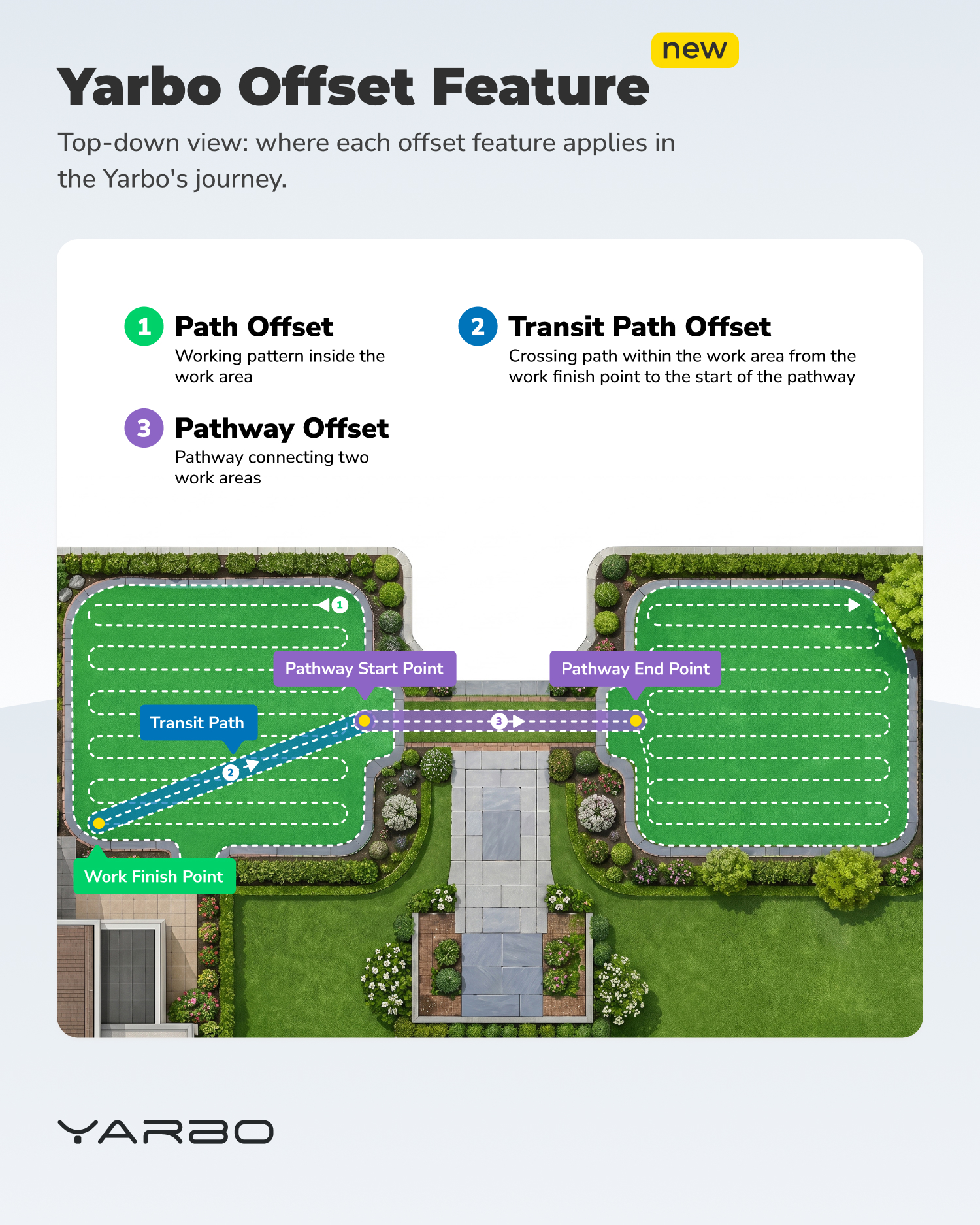
When Yarbo finishes a work plan in one work area and needs to move to the next, it must travel from its current position to the start of the connecting pathway. This internal traversal is called the transit path — and without offset variation, Yarbo would always cross the same line through the area, gradually wearing the turf along that route.
The Transit Path Offset feature distributes these traversal routes across parallel tracks on both sides of the original transit line, so the lawn isn't damaged by repeated transit movements.
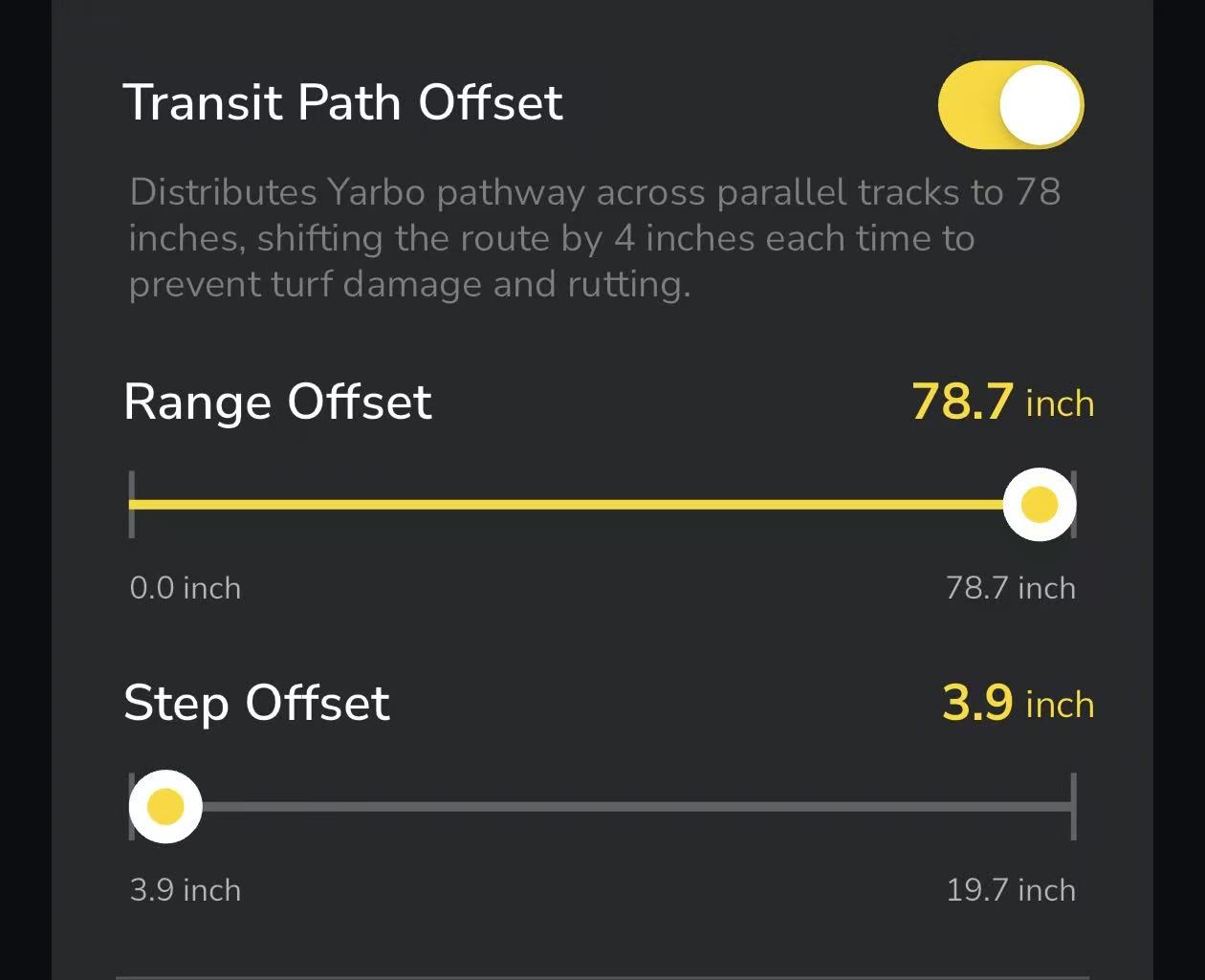
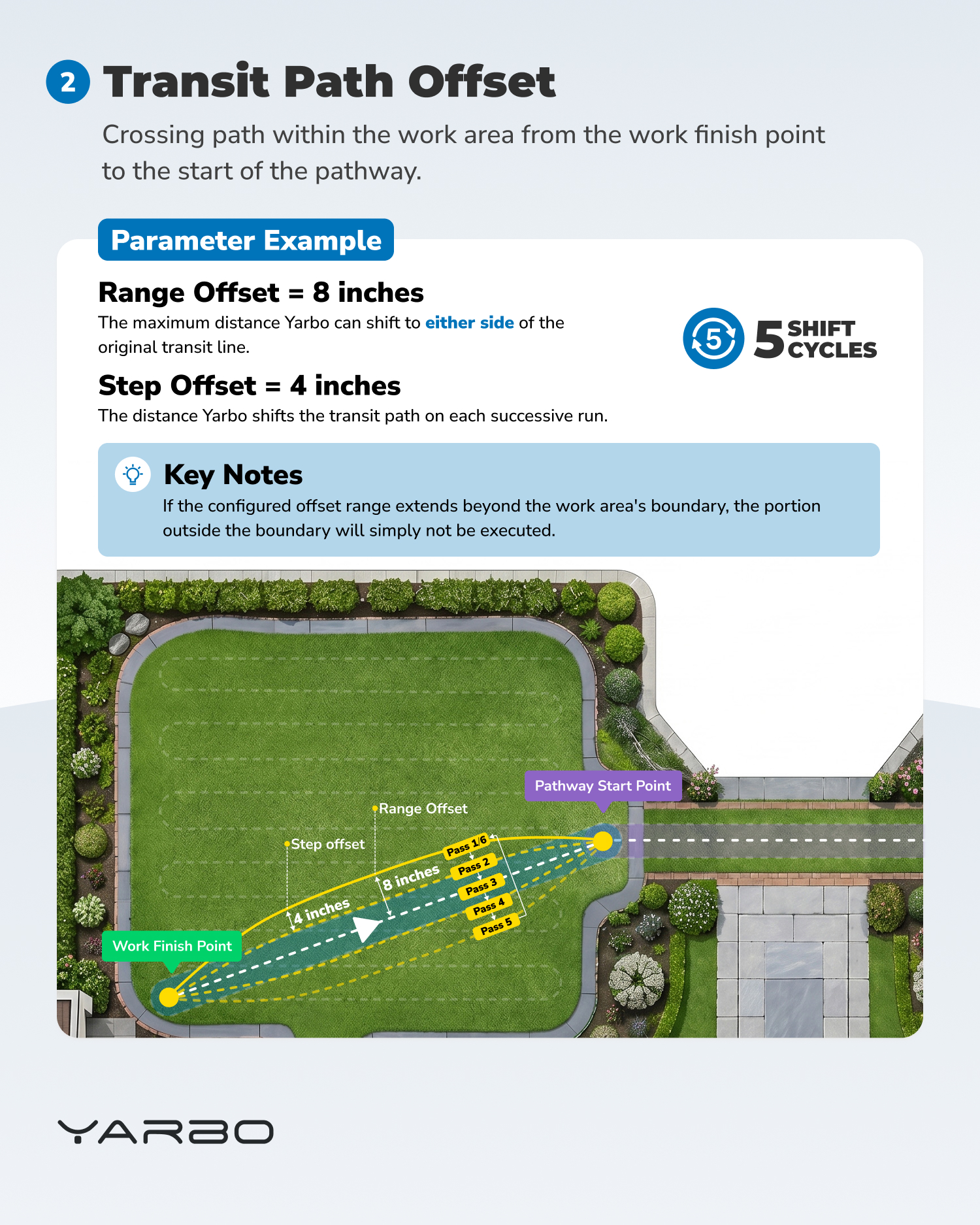
Range Offset (0.0 – 78.7 inch / 0 – 200 cm) The maximum distance Yarbo can shift to either side of the original transit line. The value represents a half-width — for example, setting Range Offset to 20 inches means Yarbo can shift up to 20 inches to the left and up to 20 inches to the right, for a total spread of 40 inches.
Step Offset (3.9 – 19.7 inch / 10 – 50 cm) The distance Yarbo shifts the transit path on each successive run. Once the cumulative shift reaches the Range Offset boundary on one side, it cycles back through and shifts to the other side.
With Range Offset = 8 inces and Step Offset = 4 inces, Yarbo can shift up to 8 inches left or 8 inches right of the original line, in 4-inch increments — producing roughly 5 distinct transit tracks distributed evenly on both sides before the cycle repeats.
If the configured offset range extends beyond the work area's boundary, the portion outside the boundary will simply not be executed. Yarbo will continue to use the offset positions that remain inside the area, but it will not attempt to travel outside the mapped boundary.
Protects High-Traffic Zones: Prevents rutting along inter-area transit routes
Symmetric Spread: Distributes wear evenly to both sides of the original transit line
Independent of Working Paths: Operates separately from the area's main working pattern
Customizable Spread: Wider ranges for sensitive turf, narrower ranges for confined areas
Note: Transit Path Offset only controls the route Yarbo takes when crossing a work area to reach a pathway entry point — it does not affect the working pattern within the area or the pathway itself.